
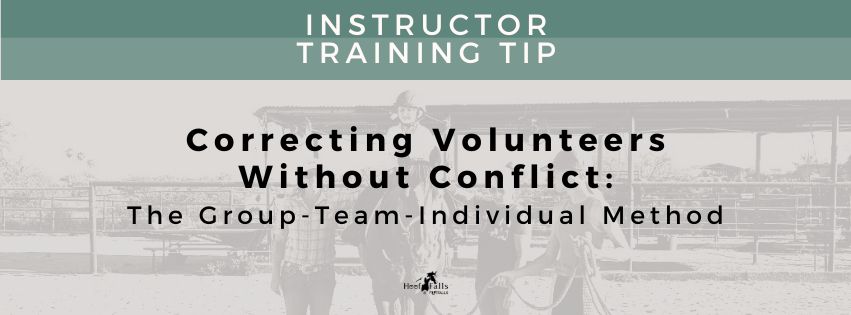
Correcting Volunteers Without Conflict: The Group-Team-Individual Method
If you’ve ever taught a busy adaptive/therapeutic horseback riding lesson, you’ve likely found yourself in this situation:
You see one or more volunteers doing something that needs correcting. Maybe they’re talking over you. Maybe they’re over-helping a student. Maybe a horse leader is holding the lead rope too short and interfering with the horse’s movement.
You know it needs to be addressed…
But how do you correct it without hurting feelings, embarrassing someone, or completely disrupting the flow of your lesson?
This is where the Group-Team-Individual method can make a huge difference.
A Simple Framework That Protects Relationships and Keeps Lessons Running Smoothly
This method helps instructors correct volunteer behavior in real time while preserving rapport, maintaining lesson flow, and demonstrating confidence and professionalism.
Let’s walk through three common scenarios and see how to use this method in action.
Example 1: The Chatty Volunteer
It’s a common one. Volunteers are chatting, sometimes with each other, sometimes with the student, and often over the top of you as the instructor. Even if their intentions are good, it becomes a distraction and prevents your student from focusing or hearing your instruction.
Step 1: Group Correction
Let’s say you’re about to introduce two-point to your riders. Instead of calling out the individuals, you address everyone at once:
“Alright everyone, our students are getting ready to put in their full focus and energy into a new skill: two-point down the long rail. I need your help. Let’s keep it quiet so they can hear any feedback I need to give them. Thank you all for supporting your riders so well.”
This phrasing invites volunteers to rally around a shared goal which is supporting the student rather than feeling called out.
Step 2: Team Correction
If one team continues chatting, you can address the team more directly as they come through:
“Johnny’s team, he’s doing this two-point on his own this round. No verbal cues or prompts this time, just silent support so we can see what he’s able to do. Thank you so much for helping him focus.”
This allows you to narrow the correction while still maintaining a positive tone.
Step 3: Individual Correction
If needed, approach the specific volunteer quietly:
“Hey Sarah, I really appreciate how engaged you are with Johnny, but I need you to stay quiet during this part so I can see how much he can focus and follow my cues. Let’s chat more after class, I’d love to explain the ‘why’ behind this so you’re set up for next week.”
By layering these steps, you reduce the chance of embarrassment and preserve trust.
Example 2: The Overly Helpful Volunteer
Sometimes your volunteers are too helpful. They are jumping in to do things your student is perfectly capable of handling independently. This often comes from a good place, but it can unintentionally hinder student progress.
Step 1: Group Correction
Set expectations before the activity:
“During this activity, I want to see how well our riders can place their reins down, pick them up, and handle the pieces themselves. Volunteers, your job is to offer verbal reminders if needed, and just hold the materials at a reachable level, but let the student do the rest. They’ve got this.”
Step 2: Team Correction
If one team continues over-helping, address the student directly (which indirectly corrects the team):
“Sally, this time I want you to manage your reins completely on your own. Sidewalkers, let’s make sure Sally is fully in charge of her reins and pieces. I can’t wait to see what she does.”
This gives the team clear direction while empowering the student.
Step 3: Individual Correction
Quietly approach the volunteer:
“Hey, I love how engaged you are with Sally. Let’s give her a few seconds to try this all on her own. That way we can see what she’s retained. If she struggles, just call me over, and I’ll step in.”
Following up after the lesson to explain the reasoning builds understanding and future cooperation.
Example 3: The Chronic Short Lead
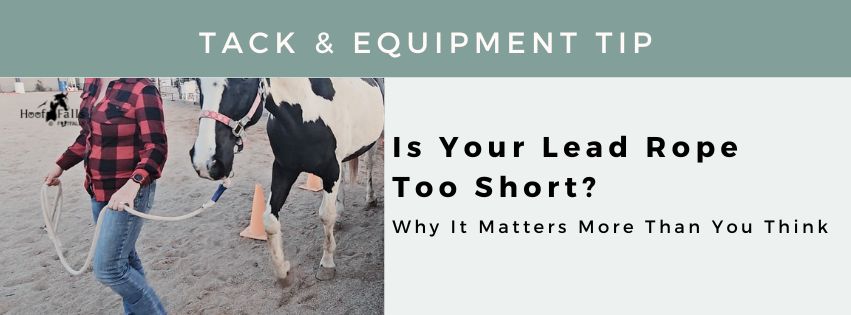
Your horse leader keeps holding the lead rope too close to the halter, restricting the horse’s movement and interfering with the student’s cues.
Set Yourself Up for Success First
Place colored tape on the lead ropes where you want volunteers to hold. This gives you a visual reference point for corrections.
Step 1: Group Correction
Before starting a pattern:
“Let’s do a quick lead rope check. If your lead has tape, make sure your hand is there. We’re about to do a pattern where I want to see our horses listening to the students’ cues, not the leaders. Let’s set our riders up for success.”
Step 2: Team Correction
If one team misses the cue:
“Ally’s team, she’s about to do the barrel pattern. I’d love to see how she handles it on her own. Can you all do a quick hand check? Ally, you too, check your reins. Great teamwork.”
Step 3: Individual Correction
Still not fixed? Quietly approach the leader:
“Jim, I really like how forward your horse is going for Ally. Can you check that your hand is on the tape? That’s going to help her horse follow her cue instead of yours. Thanks so much.”
Again, a quick follow-up after class to explain why you’re reinforcing this helps build long-term awareness.
Train Your Volunteers to Expect This System
The group-team-individual method works best when your volunteers are trained to listen for those layers of feedback. Let them know your approach ahead of time and explain how it helps everyone stay supported and successful during lessons.
With time, your volunteers will start to notice corrections at the group level and self-correct before you ever have to step in individually.
Final Thoughts: Correct with Confidence and Compassion
It takes practice to make these corrections smoothly. The first few times might feel awkward or uncomfortable, but it gets easier the more you do it.
The goal is not perfection. It’s clarity. It’s communication. It’s setting everyone up for success, your students, your volunteers, and yourself.
Have you used the group-team-individual method in your own lessons? What has worked well for you when correcting volunteers? I’d love to hear your experience in the comments.
Let’s keep learning, growing, and teaching with intention.
Responses