
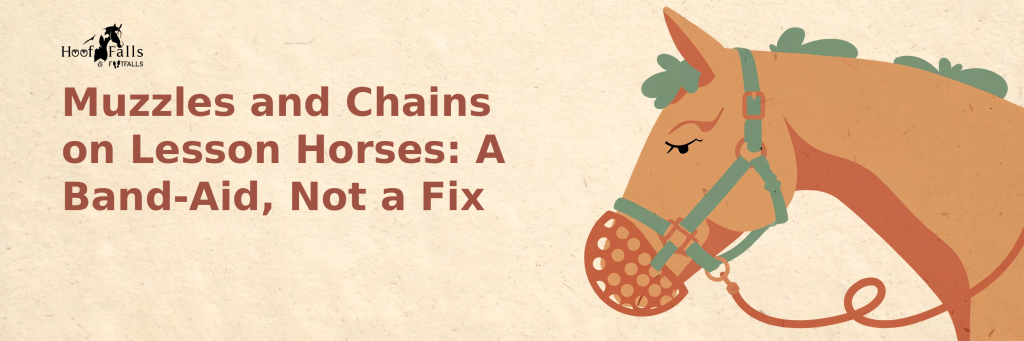
Muzzles and Chains on Lesson Horses: A Band-Aid, Not a Fix

By Saebra Pipoly | Hoof Falls & Footfalls
Let’s talk about grazing muzzles and chains on lesson horses during lessons.
Fair warning…this is one of my “soapbox” topics and it can ruffle some feathers.
I am seeing these tools used more and more to manage what gets labeled as “naughty” behavior. A horse nips at the leader, instructor, or student. A horse pushes through a stop, is hard to slow down or turn, or struggles to stand quietly for mounting and dismounting. The quick response becomes…put on a muzzle or add a chain.
To be clear, I am not talking about a horse wearing a grazing muzzle for turnout or while riding through an area with grass. That is a different conversation. I am talking about putting a grazing muzzle or chain on a lesson horse during a lesson to stop behavior we do not want.
I am seeing this more in person, at programs I visit for clinics and coaching, and in those quick social-media glimpses into lesson programs.
Most of my perspective comes from adaptive/therapeutic riding programs. Our students may have physical, cognitive, emotional, or learning needs. Lessons may also include a horse leader and one or two side walkers with different experience levels…which creates more opportunities for mixed messages.
But this conversation is not limited to adaptive/therapeutic programs. Traditional instructors also deal with mouthy, pushy, or forward lesson horses.
The root-cause questions are the same.
A stronger tool does not solve the reason behind the behavior
Early in my career, I was pushed to use chains on horses showing problem behaviors because “other programs do it.” I was not always the person making the final decision, but when a horse was assigned to my class, I tried to avoid using one.
I am a lifelong horse person who grew up working with problem horses. I know a chain can work in educated hands, for a very short period, on a significant problem after other options have been exhausted.
I have also seen chains go very wrong…even in educated hands. They can cause pain and send a horse into fight-or-flight panic. With overuse, a horse can build a “callus” and become less responsive. The handler applies more pressure, the horse becomes more reactive, and the conflict grows.
A grazing muzzle used to prevent nipping may stop the horse from making contact, but it does not tell us why the horse is nipping.
That is why I see muzzles and chains used this way as a band-aid…and probably a poor one…on a deeper problem.
Before reaching for either one, I want us to ask four questions.
1. Is it the horse?
Does this horse need more schooling between lessons? Are we asking the horse to do something he does not understand? Has the horse learned that pushing, pulling, or nipping works because people have been inconsistent?
Every interaction with a horse is either training or untraining. We do not get free passes because the horse is a lesson horse. Some horses are more forgiving, but every person who catches, grooms, tacks, leads, schools, or rides that horse is reinforcing something.
We also need to look beyond training. Does the tack fit? Is the student an appropriate size for the horse? Is the horse uncomfortable? Could arthritis, ringbone, or another developing health issue be changing what the horse can comfortably do?
If the behavior is significant enough that I am considering a muzzle or chain, I may need to pull that horse from mounted lessons while I investigate and retrain. That can be difficult…especially when the schedule is full and the horse is needed. But continuing to use the horse while covering up the behavior does not solve the problem.
2. Is it the student-horse match?
Sometimes a behavior shows up with one student but not everyone else. That matters.
Is the student too tall, too heavy, or too off balance for this horse? Are they harsh or inconsistent with their legs or reins? Are they asking the horse to keep going while the leader pulls to slow down? Think about those conflicting messages…speed up, slow down, turn, straighten, balance the student, and listen to the leader…all at once.
Sometimes the student and horse simply have an energy clash. That may sound a little “woo woo,” but most of us have seen combinations that do not work well for reasons that are hard to measure.
Look for patterns. Does the behavior happen with one student or with all students? Can we improve posture, balance, aids, or communication? Would a different horse-student match be fairer to both?
3. Is it the handler?
In adaptive/therapeutic riding lessons, the horse leader may be a volunteer with limited experience. That may mean our training has not prepared them for what we are asking them to do.
Are they giving clear, fair signals? Do they know how to slow down, stop, and turn without creating more tension? Are they positioned well? Are they so focused on the student that they are missing what the horse is communicating?
Mouthiness can begin as playful behavior and escalate when no one addresses the early signs. Mixed messages can build frustration. Sometimes a particular handler’s energy or timing does not work well with a particular horse.
Before changing the equipment on the horse, look at the person holding the lead rope…and look at the training program that prepared that person.
4. Is it the instructor?
This is the hardest question because it requires us to look at ourselves.
Do we have enough horsemanship knowledge, on the ground and in the saddle, to recognize what is happening? Can we coach the student and handler through it? Do we understand how different horses learn and respond, including the influence of individual temperament?
Horses usually whisper before they talk louder…and talk louder before they begin yelling.
Can we see the posture change, tension, head movement, hesitation, pinned ears, mixed aids, or unclear handling while it is still subtle? Or do we notice only after the horse is nipping, pulling away, pushing through a stop, or refusing to stand for mounting?
Sometimes what looks like a horse problem is actually a user problem…the student, the handler, the instructor, or a combination of all three.
That is not about blame. It is about having enough knowledge to notice sooner and change what we are doing before the horse has to communicate louder.
Play the long game
My position is simple…I do not think muzzles and chains should be used on lesson horses during lessons to control these behaviors.
If you are reaching for one, pause and reframe the problem. Is the root cause the horse, the student, the handler, the instructor, or a mix of them? Are we choosing the tool because it is fast? Because someone told us that is what programs do? Because we are afraid of losing mounted lesson time?
Yes, finding the cause takes more time. Yes, you may need to pull a horse from mounted lessons. That does not mean you stop providing a quality service. There are unmounted lessons, horseless lessons, groundwork, retraining, volunteer education, and instructor development that can continue while the problem is addressed.
A muzzle or chain may appear to protect today’s schedule, but ignoring the cause can lead to bigger behavior, more reactive horses, worried students and families, hesitant volunteers, and a program problem that is much harder to solve.
I challenge you to play the long game. Protect the horse now…because that also protects the student, the handler, the instructor, and the program.
And if you have reached the limit of your knowledge, ask for help. Take lessons. Find a coach or mentor. Join an online class if in-person support is not available. It took me far too many years to learn that asking for help is not a weakness…it is a strength.
If your program is working through exactly this kind of thing… lesson horse behavior, volunteer training, the systems underneath it all… you do not have to figure it out alone. HF&F program coaching partners with adaptive/therapeutic riding programs for twelve months of focused work: healthier horses with longer working careers, staff and volunteers who stay, and the structure that protects your mission. Learn more about coaching here: https://coaching.hooffallsandfootfalls.com/
This topic brings out strong opinions, so please be kind in the comments. If you have used muzzles or chains in lessons, I am not asking you to feel called out. I am asking you to take the information, look at the horse and the full situation, and decide what you will do next.
What are your thoughts? Have you seen a program successfully address the root cause behind these behaviors? Share your experience below…food for thought helps all of us do better.
If you want deeper guidance on lesson-horse behavior, volunteer handling, and practical instructor decision-making, visit the Intuitive Instructor Club video library for additional training and support or check out Hoof Falls & Footfalls Coaching & Consulting for programs offering equine-assisted services
You are currently on Hoof Falls & Footfalls’ learning platform. Return to our main website HERE.
Hoof Falls & Footfalls is supported by YOU! Each time you buy through affiliate links from my site, I may earn commission (at no extra cost to you). Commissions help me continue to provide free and affordable education to adaptive/therapeutic riding instructors and other Equine Assisted Services industry professionals.
Disclaimer: The information provided by Hoof Falls & Footfalls is for educational purposes only and is intended to support instructors in expanding their knowledge and skills. It is not a substitute for professional training, certification, or individual judgment. By choosing to implement any of the ideas, techniques, or practices shared here, you do so at your own risk and accept full responsibility for the outcomes. Hoof Falls & Footfalls and its creator, Saebra, assume no liability for any injuries, damages, or losses resulting from the use of the information provided. Always ensure the safety and well-being of your students, horses, and yourself by following appropriate safety guidelines and industry best practices.


Responses